
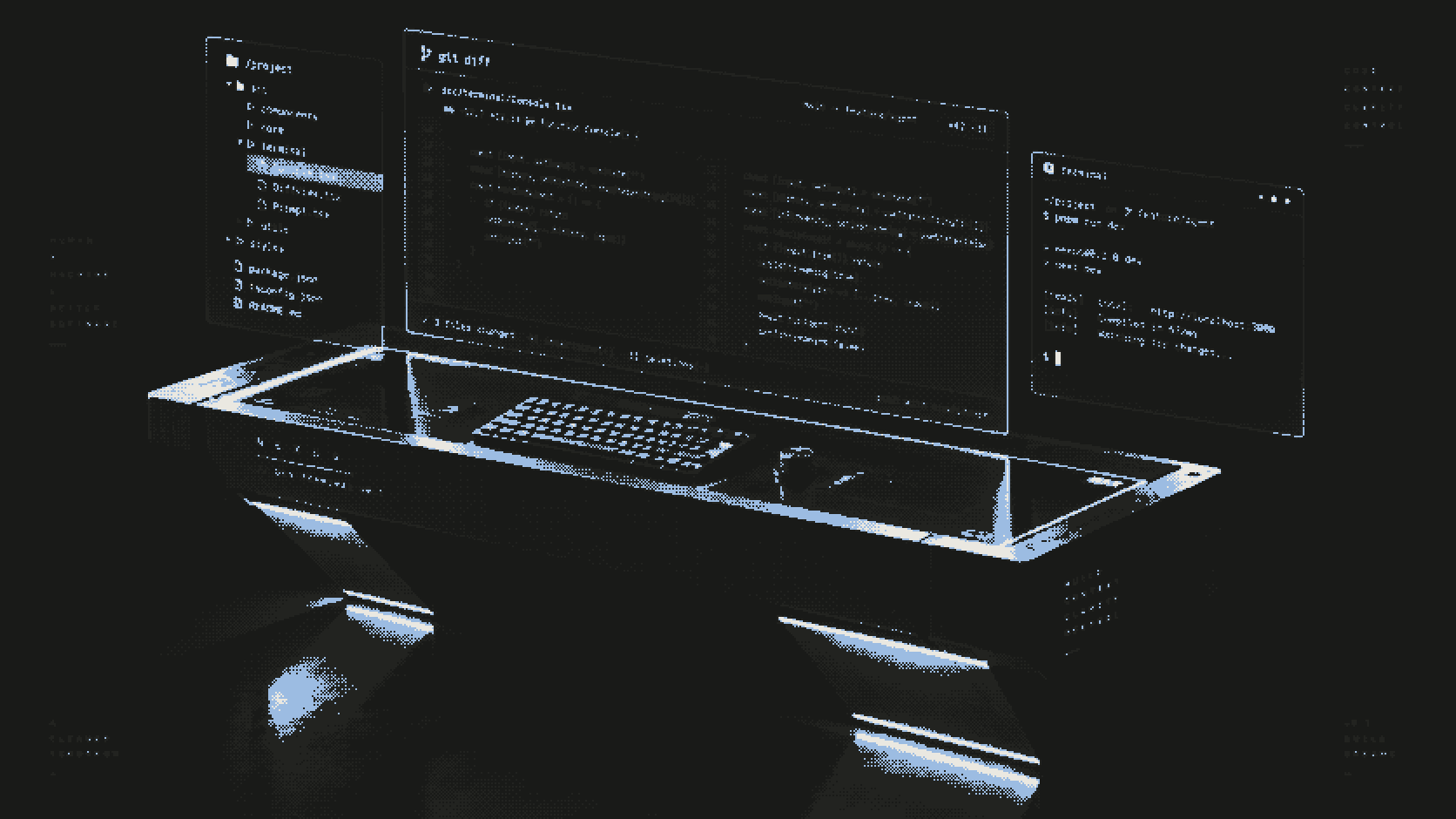
Searching for an open-source alternative to a hosted coding agent returns a mix of projects, and this is a guide to one of them. We build Shiba, so this guide explains our approach and its limits. It is not a benchmark, not a claim of feature parity, and not a live run we can show you.
Sources: README.md, PLAN.md, spec/GOAL.md, VERIFICATION.md,
and design.md. We have not run a controlled comparison against hosted
products, so nothing below claims relative speed, success rate, or cost.
Shiba is a local prototype, not production-ready. The deployed site carries the landing page, dashboard UI, and docs. The Worker backend is verified by typecheck, lint, tests, and build, plus one dated local run that reached the model call. No live end-to-end cloud run is claimed.
What the search usually means
“Open-source coding agent alternative” bundles several different requirements: readable source, a choice of agent harness, a model you pick, infrastructure you own, or a checkpoint before anything executes. They overlap but they are not interchangeable, so write down the one that matters most before comparing projects.
If the requirement is source inspection, start at the repository and the license. If it is remote execution, check what the backend actually runs on and who owns that account. If it is safety, look for where a human decision is required and whether that checkpoint is code or policy.
A tool can match your preferred interface and still be wrong for the environment your project needs. The honest comparison is between your written requirement and evidence you can reproduce on your own machine, not between two homepages.
What Shiba is
Shiba is an open-source, self-hosted AI software engineer. The repository is AGPL-3.0-only, and it is a pnpm monorepo holding a React dashboard, an Astro documentation site, and a Cloudflare Worker backend built around Agents and Sandbox containers. You describe a GitHub task, review the proposed delegation, approve or reject it, and inspect the diff the sandbox produced.
Source access is useful here because the safety claims live in code. Which operations need a human, what state the run retains, and what secrets can reach the container are all readable. Record the revision you evaluated so your findings stay attached to a specific implementation.
What a task looks like end to end
The workflow is deliberately small. You paste an HTTPS GitHub repository URL
and describe the task in the dashboard — “fix the token refresh race in
auth.ts”, not a spec. Shiba generates a proposed tool call,
delegate_coding_task, and freezes it for review.
That frozen input is the product. It names the repository, the branch, the base it diverges from, and the egress policy the sandbox will run under. Nothing executes while it is frozen. Approval starts the container; rejection discards the plan entirely.
After approval the run reports progress, changed files, and a unified diff in the dashboard. Opening a pull request is optional and only happens when you configure a GitHub token for it — diff-only tasks need no token at all.
Choose the harness and the model
A Shiba run executes OpenCode, Claude Code, Codex, or Devin CLI inside a
sandboxed container. The coding agent is a tool the run invokes, not the
product’s identity, and CODING_MODEL is a per-run selection.
Model access goes through a Cloudflare AI Gateway in your account. You add a
provider key to the gateway named default, and the container only ever
sees a dummy key. The gateway holds the credential; the sandbox never does.
That separation is the open-source case. A self-hosted binary pointed at a vendor’s locked model saves the seat fee and nothing else. The harness, the model, and the account all need to be yours at once.
The approval gate is the feature
Hosted agents differ on where the human sits. In Shiba the rule is code: no
sandbox starts before a human approves the exact tool input. Approvals
resolve in the dashboard, on an iPhone home-screen app, or on a Slack card.
The MCP surface has queue_run and run_status but no approve tool, so
a queued run cannot approve itself.
Automations get the same treatment. Cron, GitHub, Slack, webhook, and manual triggers all queue an approval by default. Unattended mode exists only for pull-request-only mutations on an explicit repo allowlist.
Where tasks can come from
The approval gate only earns its keep if starting a task is cheap, so the
entry points follow you rather than the other way around. A @shiba mention
in Slack, a /shiba command in Telegram or Discord, the mobile web app, and
the dashboard all land on the same frozen-input review.
The trigger channel does not change the gate. A task queued from a phone at 11pm produces the same reviewable proposal as one typed at your desk.
Compare against your actual requirements
| Requirement | Shiba’s approach | What to verify |
|---|---|---|
| Inspectable source | AGPL-3.0 monorepo, three apps | The revision you plan to run |
| Harness choice | OpenCode, Claude Code, Codex, Devin CLI | Authentication in your environment |
| Model choice | BYOK through your AI Gateway | Provider key in gateway default |
| Approval before execution | Required human gate, code-enforced | Approval list and entry points |
| Credential isolation | Container sees a dummy key only | Egress interception code |
| Failure reporting | Real exit code, bounded stderr tail, error envelope | A failing task’s record |
| Compute ceiling | standard-4: 4 vCPU / 12 GiB / 20 GB |
Your build’s actual footprint |
A missing row is a reason to keep looking, not a reason to assume a workaround. The compute ceiling is real: heavy builds and large monorepo test suites are out of reach on this platform by design.
What it costs you to run
The infrastructure cost lands on your Cloudflare account — a Worker, Durable Objects, a Sandbox container per run, KV, D1, and an AI Gateway. There is no seat fee because there is no vendor between you and the platform. The real cost is operational: you keep the Worker updated, you rotate the provider keys, you read the diff.
Model spend is also yours. The gateway meters each run against your provider key, so a cheaper model choice shows up directly on your bill rather than inside a credit bundle you cannot audit.
Run one bounded check before trusting it
Clone the repository and run the same commands the project verifies itself
with: pnpm typecheck, pnpm lint, pnpm test, pnpm build. A
wrangler deploy --dry-run exercises the backend shape further if you
have a compatible container engine.
Read VERIFICATION.md before deciding anything. It is dated, it labels
what was checked, and it records the failures alongside the passes. A
prototype whose verification file admits what it could not check is easier
to trust than a polished demo you cannot reproduce.
When Shiba is a fit to evaluate
Shiba fits when you want the approval gate, the egress boundary, and the harness-model-account combination, and you can accept the standard-4 ceiling and a prototype’s evidence level. It does not fit when you need a production service today, bigger machines, or a managed vendor to operate.
Read next: why self-host a coding agent at all and approvals in Slack, not another dashboard.