
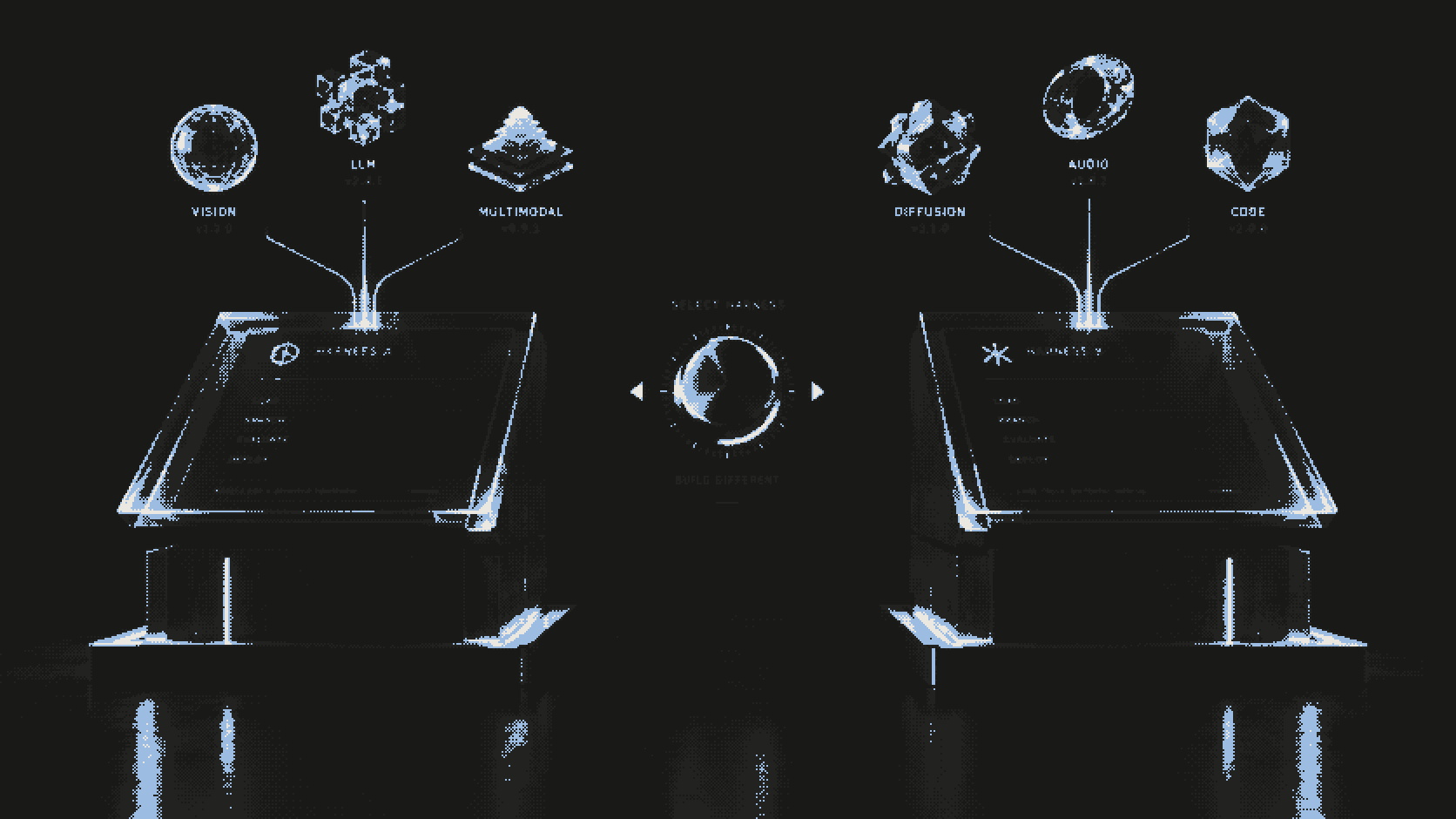
This post is a situation, a complication, and a resolution. It is about how you pick a coding harness and model for a run in Shiba, and about why the accompanying documentation refuses to tell you which option is faster or cheaper.
Sources: README.md, apps/web/src/content/docs/docs/claude-code.mdx, and
apps/web/src/content/docs/docs/costs.md. Shiba is a local prototype. No live
end-to-end cloud run, benchmark, latency figure, or dollar saving is claimed
here.
Harness selection is unit-tested. The one recorded local end-to-end exercise returned a 401, so no successful model call is claimed for any harness, and no cost or latency comparison appears in this post.
The situation: two dials
Shiba ships four coding harnesses in one pinned image: opencode (the default,
invoked as opencode run --format json), claude-code (claude --print --output-format stream-json), codex (codex exec --json), and devin
(devin -p, Cognition’s Devin CLI). Aider is not implemented.
Two settings control the default pair. AGENT_HARNESS selects the harness and
defaults to opencode. CODING_MODEL takes any provider/model the selected
harness supports. The deploy defaults in README.md include GATEWAY_ID as
default, ORCHESTRATOR_MODEL as @cf/meta/llama-3.1-8b-instruct, and
CODING_MODEL as google/gemini-3.5-flash-lite. Devin has its own
DEVIN_MODEL deploy default, with devin/swe-2 as the default model.
AGENT_HARNESS is only the deployment default. The dashboard’s New Coding Task
form picks the harness per run, and per-run selection overrides the deploy
default. A run is therefore a choice, not a property of the deployment.
The rules for a valid pairing
The model namespace has to match the harness. claude-code.mdx lays out the
supported sets: OpenCode covers google/*, anthropic/*, openai/*, and xAI
models such as xai/grok-4; Claude Code takes anthropic/*, for example
anthropic/claude-sonnet-4-6; Codex takes openai/*, for example
openai/gpt-5.3-codex; Devin takes devin/*.
An unsupported pairing is refused while preparing the approval, before
execution, with a message naming what the harness does support. VERIFICATION.md
records where that refusal lands: on the approval card, never inside a container
the human already approved.
The same document warns about model id churn. Model ids retire, and
gemini-2.0-flash was shut down on 2026-06-01, which is why the default moved.
The checked-in model name is not a service guarantee. Verify availability in
your own account.
The complication: the numbers are missing on purpose
Here is the part that is easy to misread. README.md says tokens dominate the
Cloudflare bill, roughly 20 to 40 times the compute cost, so provider choice is
the lever that matters. That sentence is a rough claim in a README, not a
measurement.
costs.md takes the number back out. It states that no prices or free-use
guarantees are given, and that no measured price or end-to-end cloud usage is
available in the dated verification record. The earlier cost-ratio language is
intentionally omitted there because it is not evidenced.
Read the two documents together and the position is clear. Provider choice is the variable most likely to matter for your bill. This repository does not measure how much, and will not estimate it for you.
What the harness tests do and do not prove
claude-code.mdx covers selection, argv, config, and env construction, provider
allowlists, and event parsing. It then draws the line in the same paragraph:
these tests do not prove the CLIs can complete a task end to end.
The verification record is specific. One local wrangler dev end-to-end
exercise with OpenCode on 2026-09-19 returned a 401, so inference and
successful completion were not verified. No live cloud end-to-end run has been
performed. Claude Code, Codex, and Devin have unit coverage only.
So OpenCode is the only harness that has been exercised against a live CLI, and
that exercise did not reach a successful model call. The other three parsers are
asserted from their documented stream formats. README.md treats harness CLI
bumps as breaking for that reason, because a stream-format change makes a run
look like it hangs rather than fail.
The credential constraint on your choice
Your harness choice constrains your credential options. Claude Code and Codex are API-key harnesses only. Subscription credentials are deliberately not proxied, because Anthropic’s terms forbid a third party routing requests through Free, Pro, or Max plan credentials on a user’s behalf.
One more limit to know: registry.npmjs.org is not on the egress allowlist, so
npm install inside a run is refused. Plan for a repository that is already
installable, or install before you queue the run.
The resolution: publish limits, not verdicts
The costs document answers the question with a limits table instead of a leaderboard. Maximum concurrent coding runs and configured container instances is 5. The OpenCode timeout is 15 minutes. The Git command timeout is 5 minutes. The collected diff is 120,000 characters, the transcript diff display is 20,000, the stderr tail is 8,000, captured files cap at 50, per-file captured contents at 100,000 characters, and total captured contents at 500,000.
Those are application settings, not Cloudflare plan quotas and not guaranteed in-memory read bounds. Capture truncation can make a publication incomplete.
The honest procedure is therefore: pick the harness your task shape fits, pick a model its namespace allows, let the config check refuse anything invalid before you approve, and read your own account’s pricing pages. The repository gives you the shape of the choice. It does not give you a winner.
Read next: what a failed run looks like.