
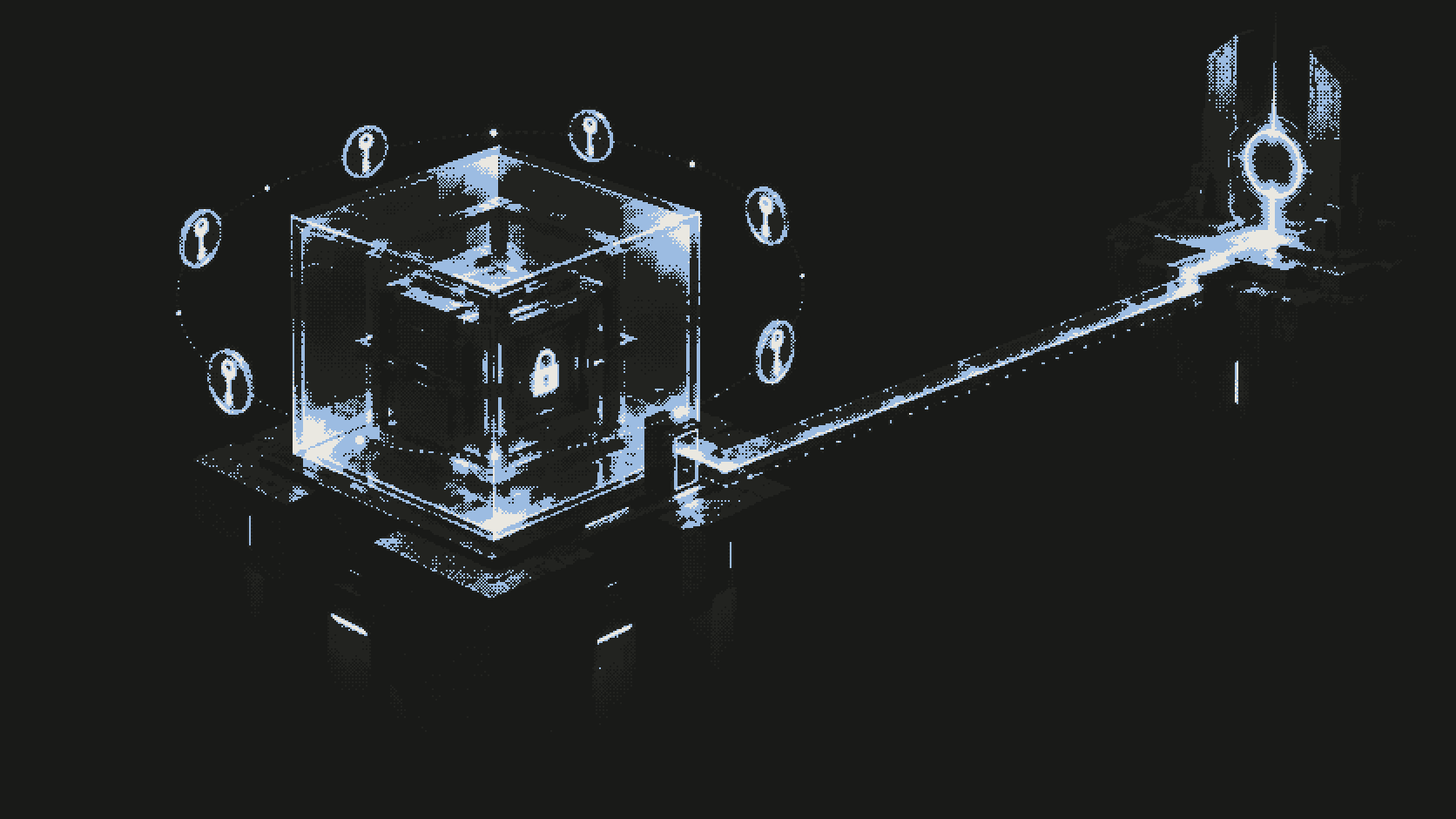
This post is a choreography. It follows four actors across time and shows where each secret lives at every step. The cast is the sandbox container, the Sandbox Durable Object, the Worker, and Cloudflare AI Gateway.
Every detail here comes from README.md and
apps/web/src/content/docs/docs/security.md. Shiba is a local prototype with
unit coverage on these paths. That is not proof of a cloud deployment, and this
post makes no claim about a live end-to-end run.
The credential boundary has unit coverage using fakes.
security.md says not to treat that as proof of a cloud
deployment, and no inference success is claimed here.
The one-sentence rule
README.md says it directly: do not add provider credentials to the container.
The container receives DUMMY_PROVIDER_KEY. The Sandbox Durable Object swaps in
the real AI Gateway credential outside the container, at egress. The credential
invariant holds for every harness.
That is the whole design in one sentence. The rest of this post is the consequences.
Actor one: the container
The container is the least privileged actor and the most noisy one. It clones a repository, runs a coding harness, writes files, and streams output back to the parent UI. It has a working key-shaped value and nothing behind it.
security.md states that provider credentials are not supplied to
provider-backed harnesses in the container. They receive a dummy key, and
provider requests are forwarded at Sandbox egress, in
apps/backend/src/egress.ts.
spec/GOAL.md puts the same rule in the sandbox’s own requirement list as item
seven: never pass real model-provider credentials into the container process.
It also says the real provider key or Unified Billing credential must stay in AI
Gateway, outside the container.
Actor two: egress
The dummy key has to work well enough that a harness does not notice the swap. The container calls its selected provider host, and the request is intercepted and forwarded through the configured AI Gateway binding.
spec/GOAL.md describes the mechanism for the default path: intercept the
container’s HTTPS egress in the Sandbox Durable Object and forward the
provider-native request through the account owner’s AI Gateway binding.
security.md adds two constraints worth naming. Egress is narrowed to the
selected harness’s provider host plus git, never the union across harnesses.
There is no provider callback route. Inference is outbound only.
Actor three: AI Gateway
Gateway is where the real credential lives. README.md notes that adding a
provider key (BYOK) to the default AI Gateway is still a manual step.
security.md is careful about what forwarding proves: successful inference
still depends on account configuration and credentials. A 401 from a provider
is a real failure, and troubleshooting.md is direct about it. A 401 means the
provider call was not successful, and egress routing alone is not inference.
Actor four: the Worker and GITHUB_TOKEN
Git is a separate credential with a separate handoff. spec/GOAL.md allows
GITHUB_TOKEN only as a Wrangler secret, and only for optional GitHub access.
Public repositories and diff-only tasks must work without it.
If publishPullRequest is true and no token exists, the system must fail before
coding with a clear configuration error. If it is configured, the token stays
out of the container. Git transport authorization is injected through Sandbox
HTTPS interception, and the pull request API is called from Worker code.
The same line lists where the token must never appear: a clone URL, a command,
the process environment, a log, or a UI response. security.md compresses it:
GITHUB_TOKEN is attached in the Worker, never in the container. README.md
adds that it is scoped to the approved repo for git traffic, is also used for
Worker-side PR publishing, and should be a fine-grained token scoped to that
repo.
Time, as a sequence
Fold the actors into order and the run reads like this.
- A human approves a plan. No container exists yet.
- The sandbox validates an HTTPS GitHub URL, clones the requested branch, and starts a harness.
- The harness is handed a dummy key, and the process environment contains no real credential.
- The harness makes a provider request to its allowed host. Egress intercepts it and forwards it through AI Gateway, which holds the real key.
- Git traffic is authorized in the Worker, not the container.
- On completion, cancel, or reclaim, the sandbox is destroyed.
Each step hands the work forward without handing over the secret.
The Devin exception
One harness does not fit the AI Gateway shape. The devin harness is not an AI
Gateway provider. Its CLI authenticates to Cognition’s own backends with an
account API key set as a Worker secret, DEVIN_API_KEY. The container’s
credentials.toml carries a dummy, and the egress forwarders replace the
authorization header with the real Bearer.
The invariant survives the exception, but only because the swap happens in a different place.
What is not claimed
security.md is explicit that these boundaries have unit coverage and that you
should not treat that as proof of a cloud deployment. The unit tests use fakes.
VERIFICATION.md lists the live cloud run as not attempted.
Two things are deliberately absent from this post. There is no measured price or end-to-end cloud usage to report, and there is no latency comparison between configurations. The costs document omits earlier cost-ratio language on purpose, because it is not evidenced.
Read next: harness and model choices.